
What a “name available” result really means (and what it doesn’t)
An availability result, whether it comes from the preliminary search on this site or from a state website, means one thing: no exact or closely matching entity name was found in that state’s register at the moment you searched. It is a strong signal, not a grant. Three limits matter:
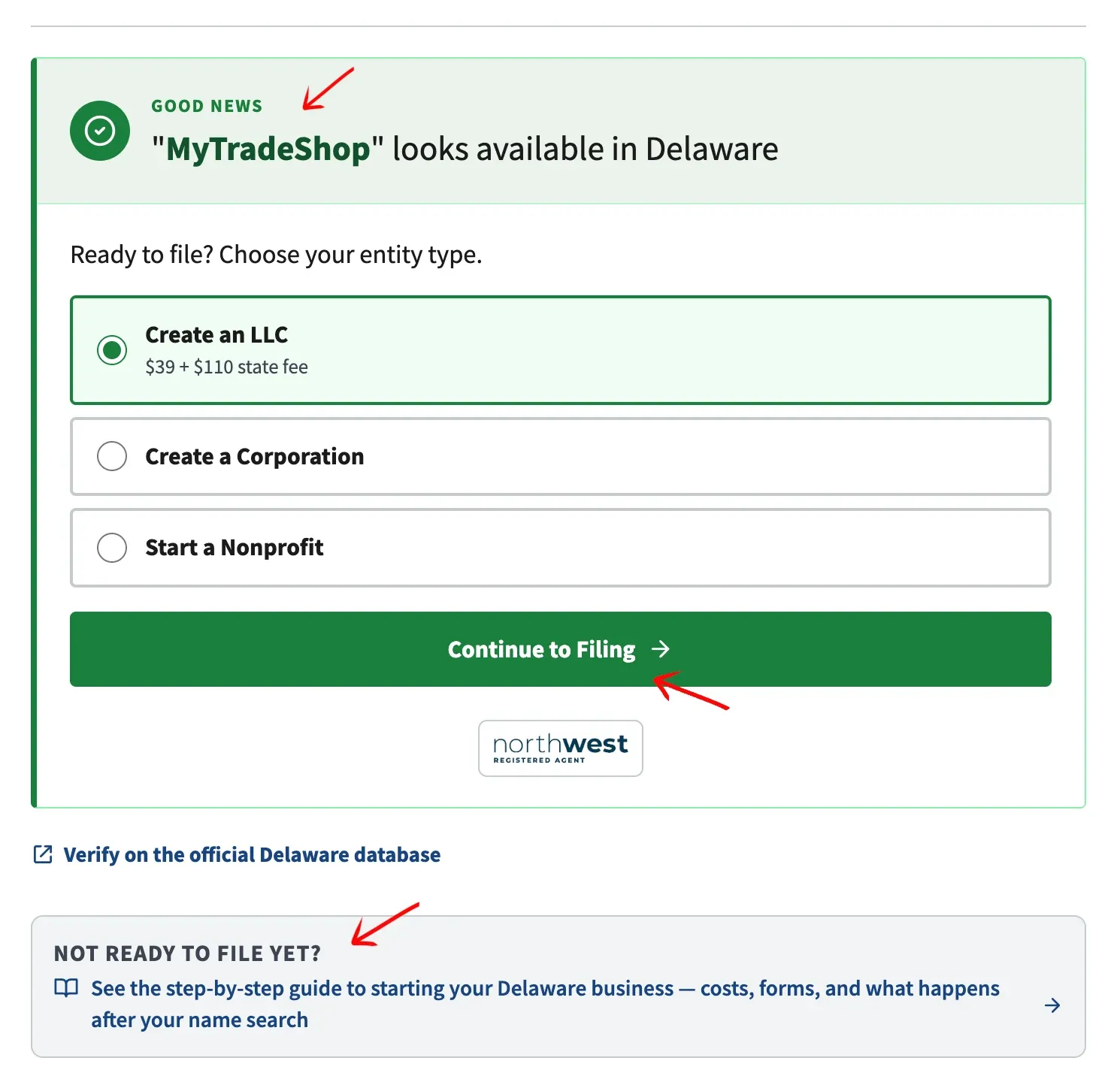
Someone else can file the same name an hour later.
Examiners apply distinguishability rules: punctuation, designators like “LLC” or “Inc.”, and words such as “a” or “the” usually don’t make a name different enough. A name that looks free can still be rejected as too similar to an existing one.
Claiming a name in your state does not stop an unrelated company from using it elsewhere. That protection comes from trademarks, not registration. Our guide to how U.S. registries work explains why there is no national register.
Before filing, verify the result yourself on your state’s official business database. Official records always outrank any third-party search, including ours. Haven’t run a search yet? Open the state guide with the free preliminary name search and come back with a result.
If your name turned out to be taken or too similar: adjust the distinctive part of the name (not just the designator), consider operating under a DBA/trade name owned by a differently-named entity, or pick a new name entirely and re-check it. The steps below are the same either way.
Step 1: Choose your entity type (LLC, corporation, or nonprofit)
The name is claimed by the entity you register, so the entity type comes first. Most small businesses choose a limited liability company for its simple paperwork and flexible taxes; corporations fit businesses raising investment; nonprofits serve a public mission and can pursue tax exemption. A one-screen comparison:
| Entity type | Best for | Formation document | Ongoing paperwork |
|---|---|---|---|
| LLC | Most small businesses, freelancers, rental holdings | Articles of Organization (some states: Certificate of Formation) | Low: annual or biennial report in most states |
| Corporation | Startups raising capital, businesses issuing shares | Articles of Incorporation | Higher: bylaws, board minutes, annual report |
| Nonprofit | Charitable, educational, or religious missions | Nonprofit Articles of Incorporation | Higher: adds the IRS 501(c)(3) application for tax exemption |
Your choice also fixes the designator your name must carry: “LLC”/“L.L.C.” for a limited liability company, “Inc.”/“Corp.” for a corporation. The name you claim is the full legal name including the designator.
Step 2: Reserve the name, or just file first
If you are ready to form the company now, skip reservation and file. A formation filing claims the name and creates the company in one step, so a separate reservation fee buys you nothing extra. A name reservation makes sense only when you need the name held while something else finishes: financing, a partner decision, licensing, or paperwork you can’t complete yet.
Most states let you reserve a name for 30–120 days for a small fee, filed with the same office that handles formations. In your state, a name reservation currently costs $. A reservation is still not trademark protection. It only blocks registrations in that one state, for a limited time.
Step 3: Appoint a registered agent
Every state requires each registered company to name a registered agent: a person or company with a physical street address in the formation state, available during business hours to receive legal documents and official mail. You cannot file formation documents without one, so decide this before Step 4.
You can be your own agent if you have a street address in the state and don’t mind two tradeoffs: your address goes on the public record, and you must actually be reachable there, because a missed lawsuit notice can become a default judgment. A commercial registered agent service costs roughly $100–300 per year and keeps your home address off the record.
If you plan to use the guided filing in Step 4: Northwest Registered Agent includes a full year of registered agent service with its formation filing, so this step is covered without a separate signup. See the formation service.
Sponsored · We may earn a commission if you form through Northwest Registered Agent. Final name approval is always made by the state.
Step 4: File your formation documents with the state
This is the step that actually claims the name. For an LLC you file Articles of Organization (called a Certificate of Formation in some states); corporations file Articles of Incorporation. The form asks for the company name with designator, the registered agent and address, the management structure, and an organizer’s signature. Every state charges a filing fee; most fall between $35 and $300. The your state LLC filing fee is currently $.
You can file directly with the state. No service required. Nearly every state accepts online filings through the same office that runs the business database, and doing it yourself costs only the state fee. Start from your state’s Secretary of State website, or open the state’s guide on this site for the official links and screenshots of the state’s own system.
What guided filing looks like, screen by screen
If you’d rather have the documents prepared and filed for you, this is the entire flow of Northwest Registered Agent’s formation wizard, captured screen by screen so you know exactly what you’re signing up for before you click anything. The service costs $39 plus your state’s filing fee and includes the first year of registered agent service.
Open the formation wizard and pick your state
The filing service starts by asking where the company will be formed. Formation is state law, so the fees, the processing time, and the exact form all depend on this choice.
Open the formation wizard and follow along →
Sponsored · We may earn a commission if you form through Northwest Registered Agent.
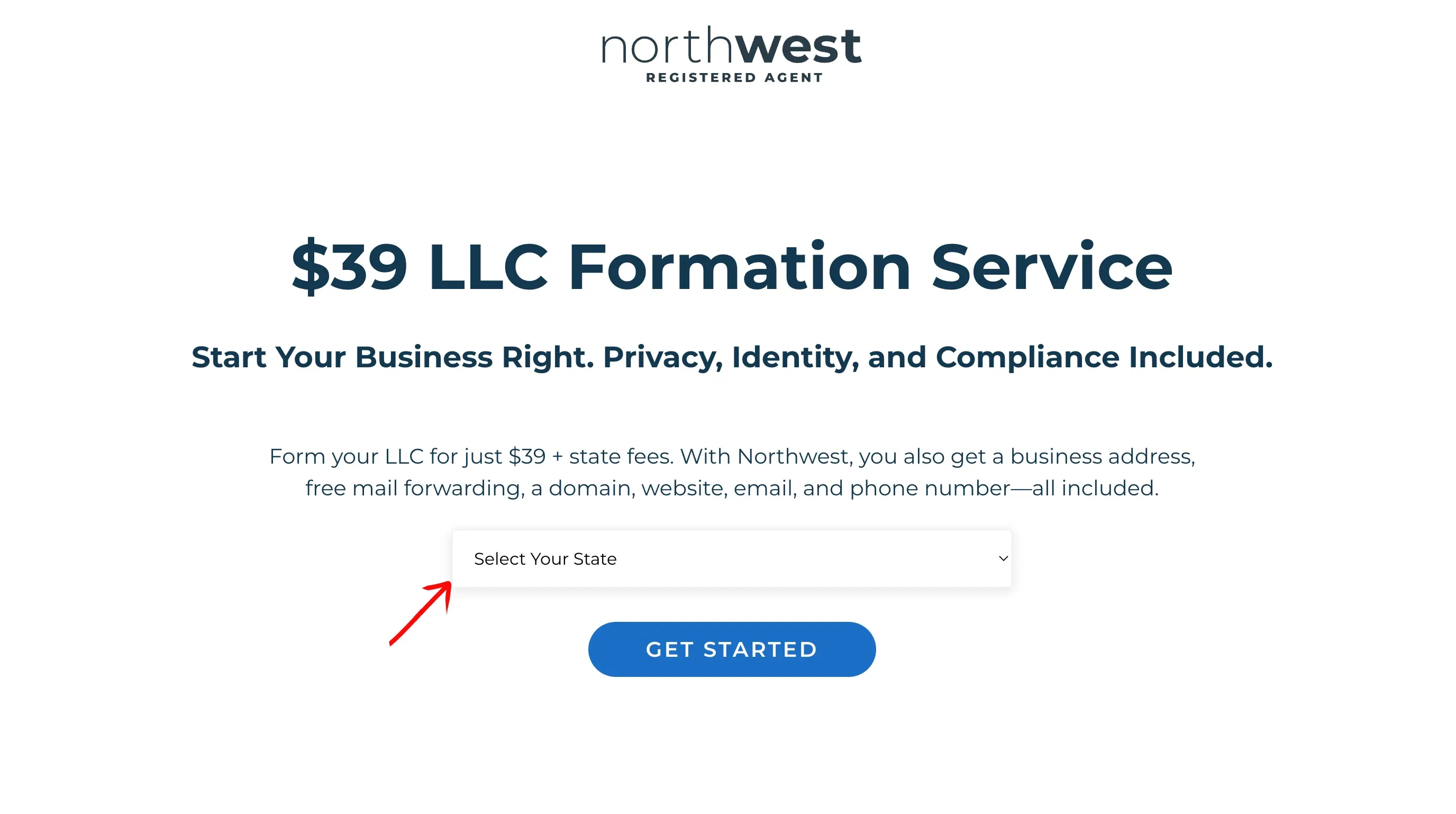
Every state and DC is available
Pick the state where you checked name availability. Filing in a different state means your name check does not apply, because each state keeps its own name register.
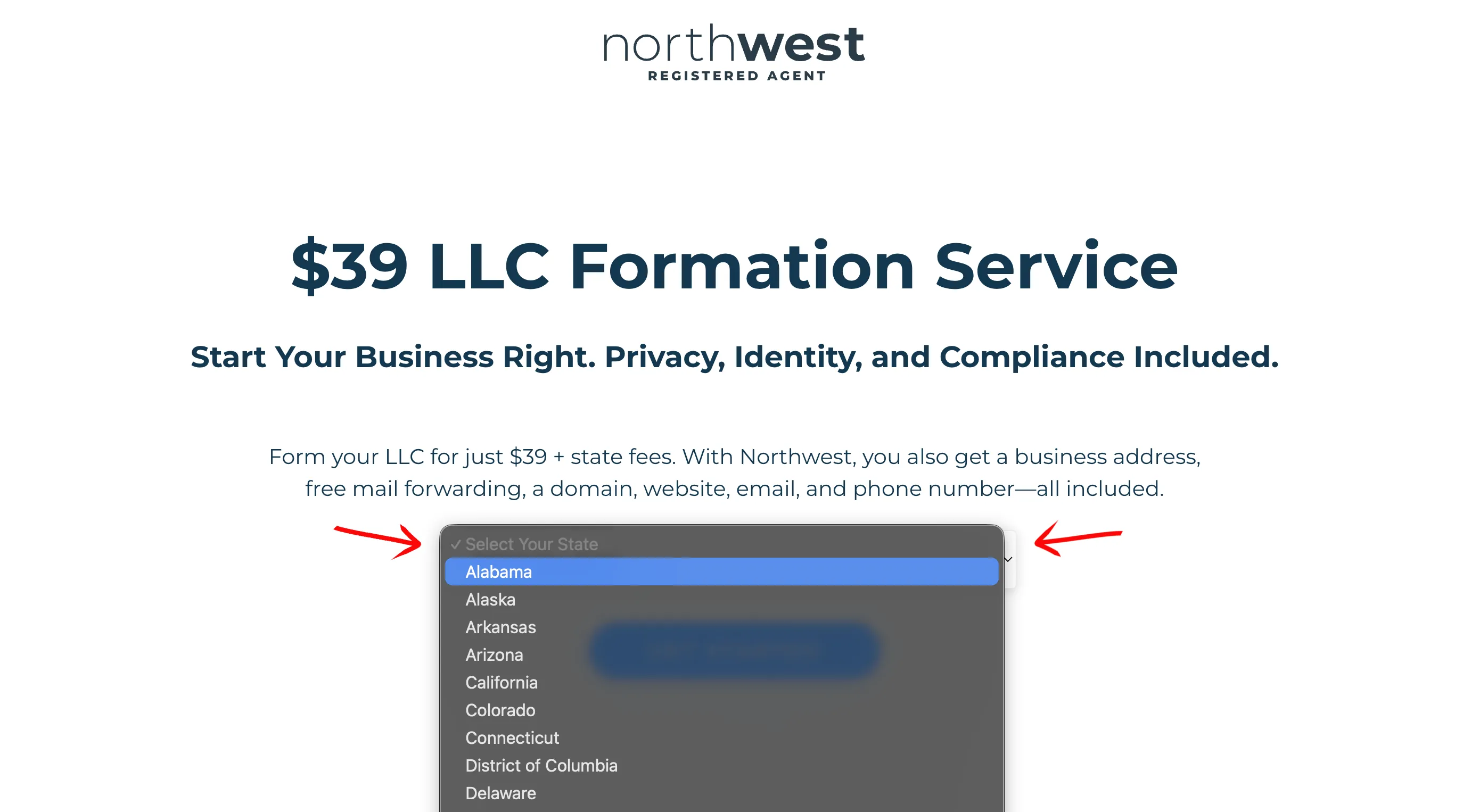
Confirm the formation state
Double-check the state before continuing. The service fee stays the same; the state fee added at the end is set by the state, not the service.
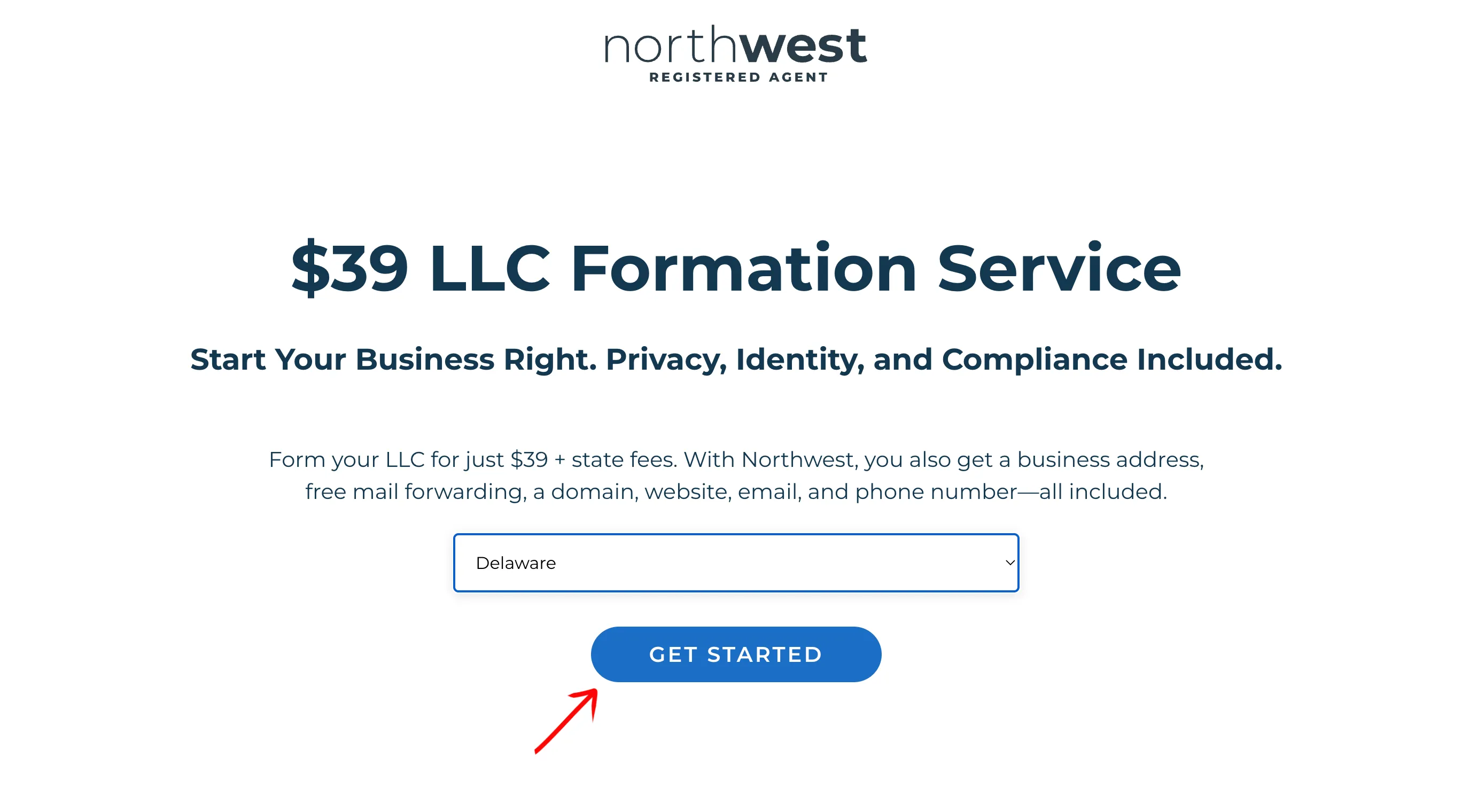
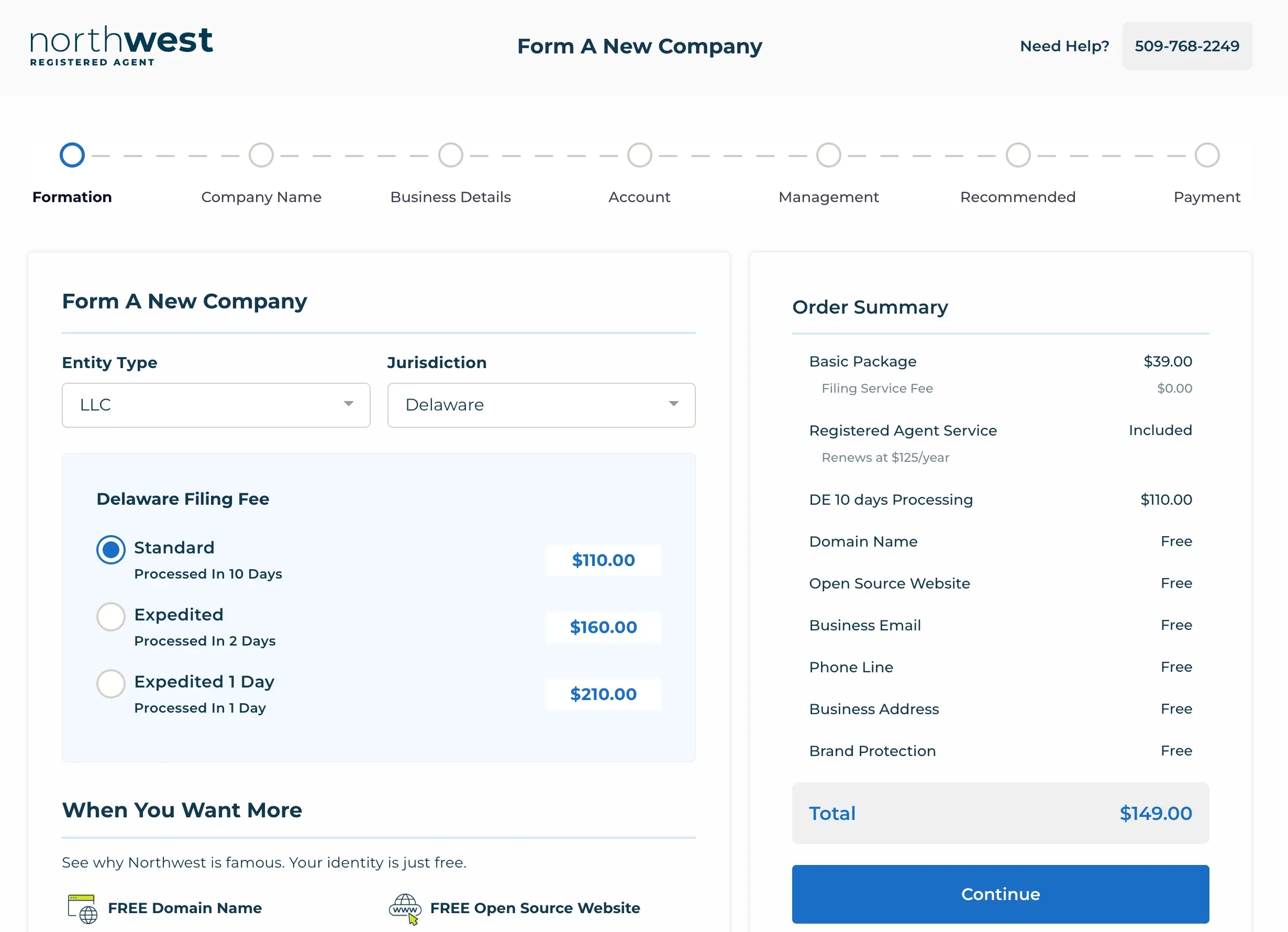
Choose entity type and filing speed
The wizard defaults to an LLC and shows the state’s processing options. Faster processing costs more and is paid to the state. If you are not in a hurry, standard processing does the same thing.
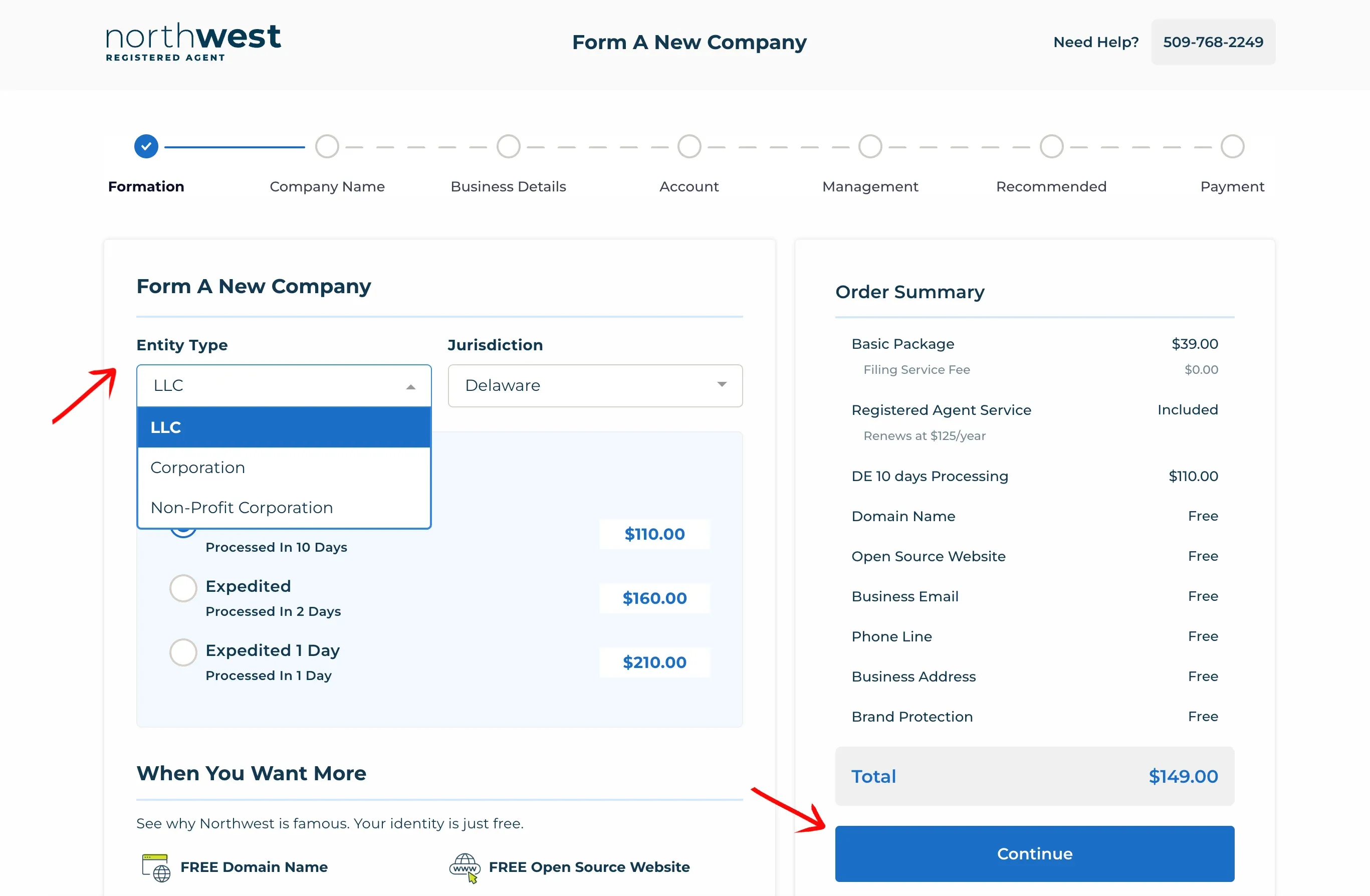
LLC, corporation, or nonprofit
All three entity types from Step 1 of this guide are available in one dropdown. Your name designator will need to match the type you pick here.
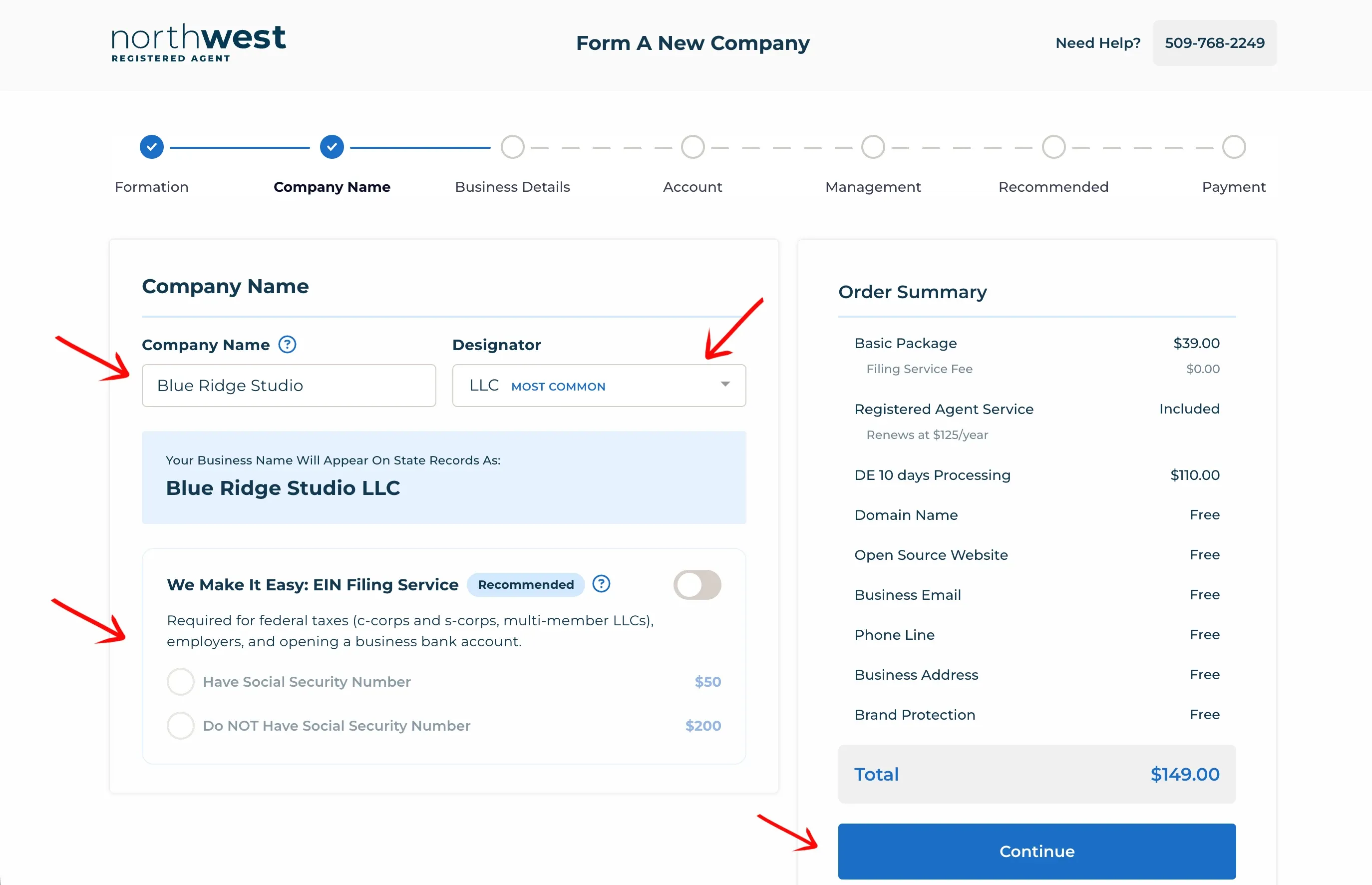
Enter your business name and designator
This is where the name you checked gets typed in, with the designator chosen separately. One honest note: this screen offers a paid EIN filing add-on. You can skip it, because an EIN is free directly from the IRS (Step 5 below).
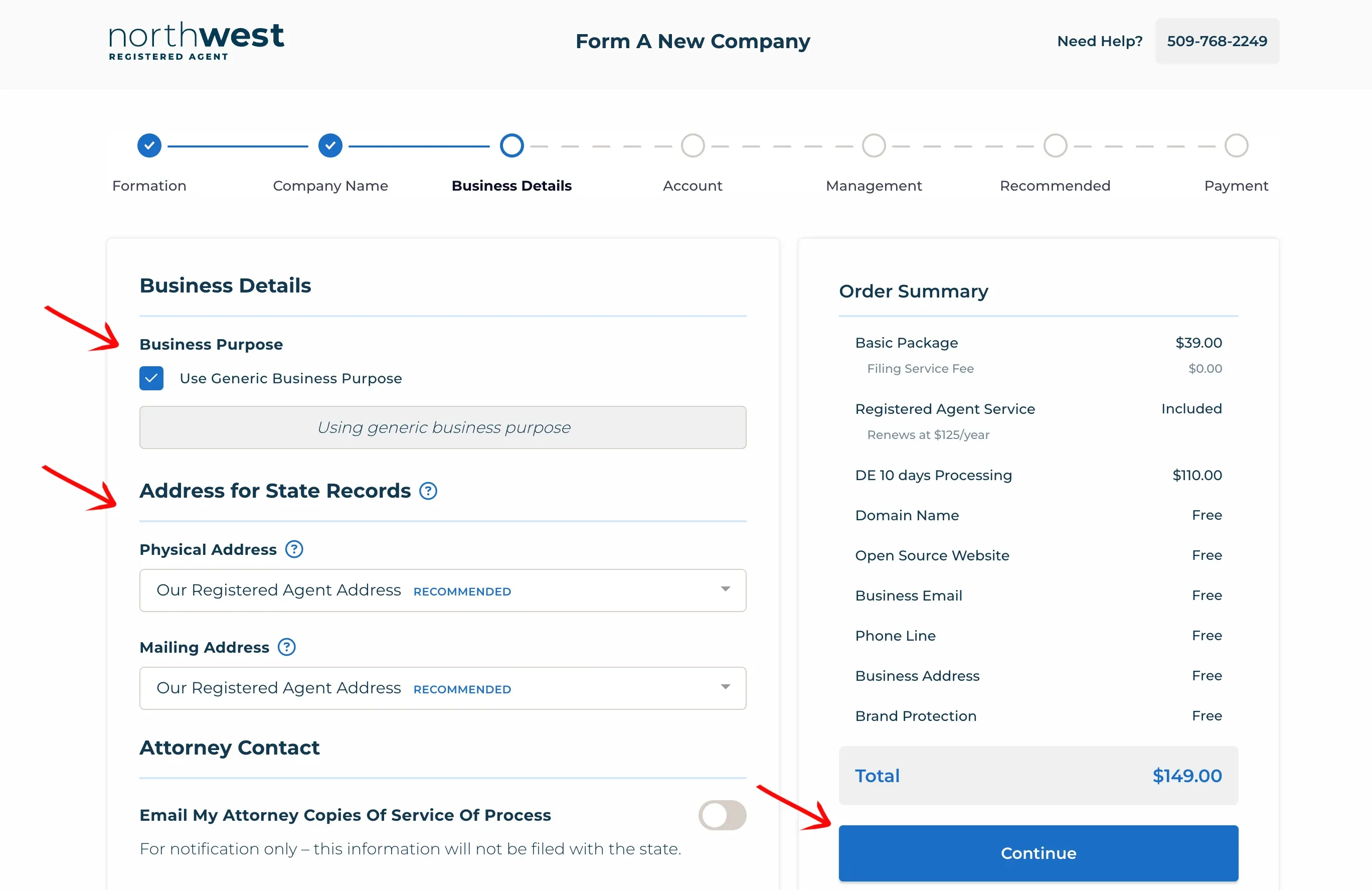
Business details: use the agent’s address for privacy
Formation documents become public records. Using the registered agent’s address for state records instead of your home address is the main privacy benefit of a commercial agent.
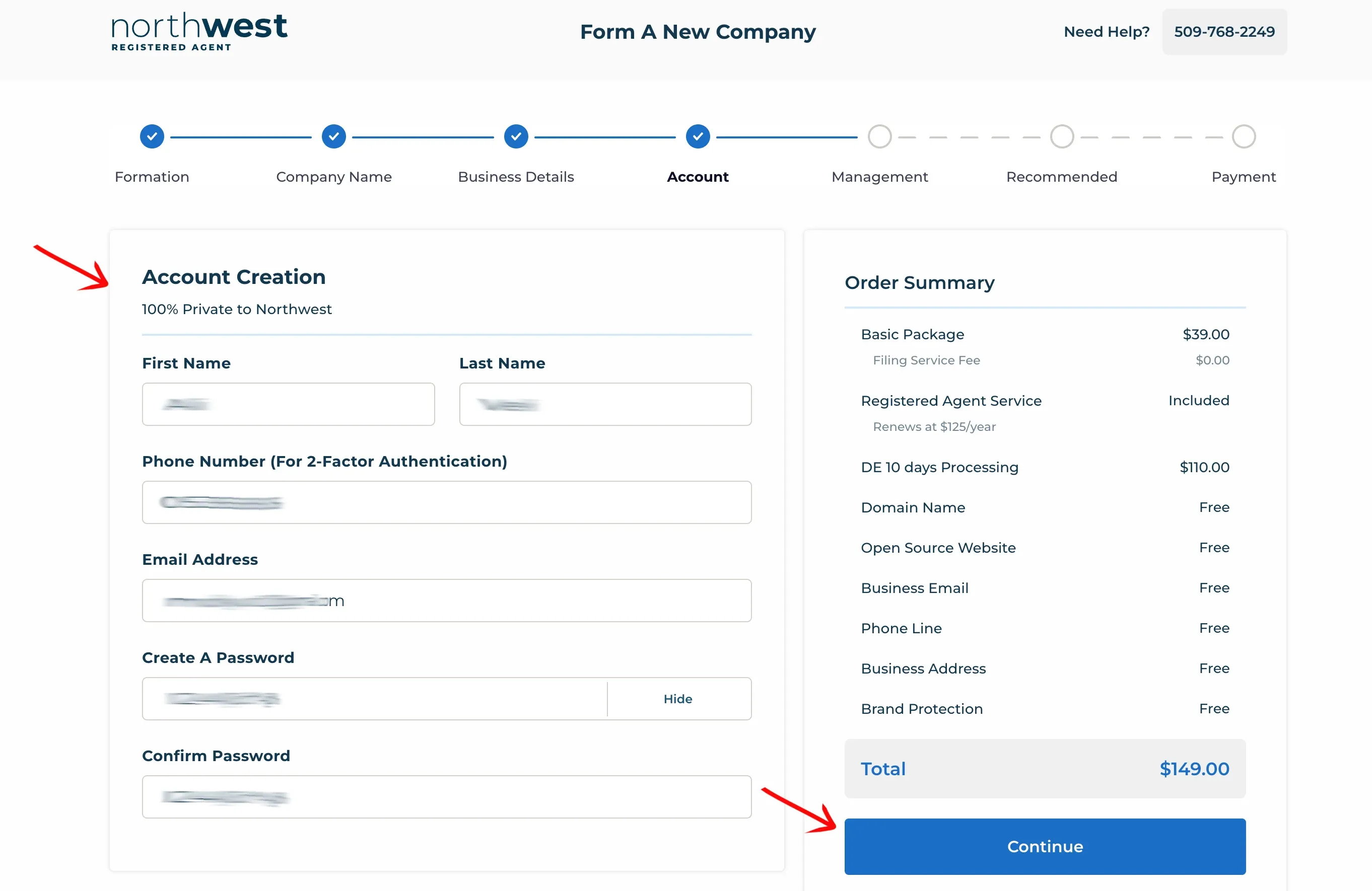
Create your account
Standard contact details and a password. This account is where your filed documents and future compliance reminders will live.
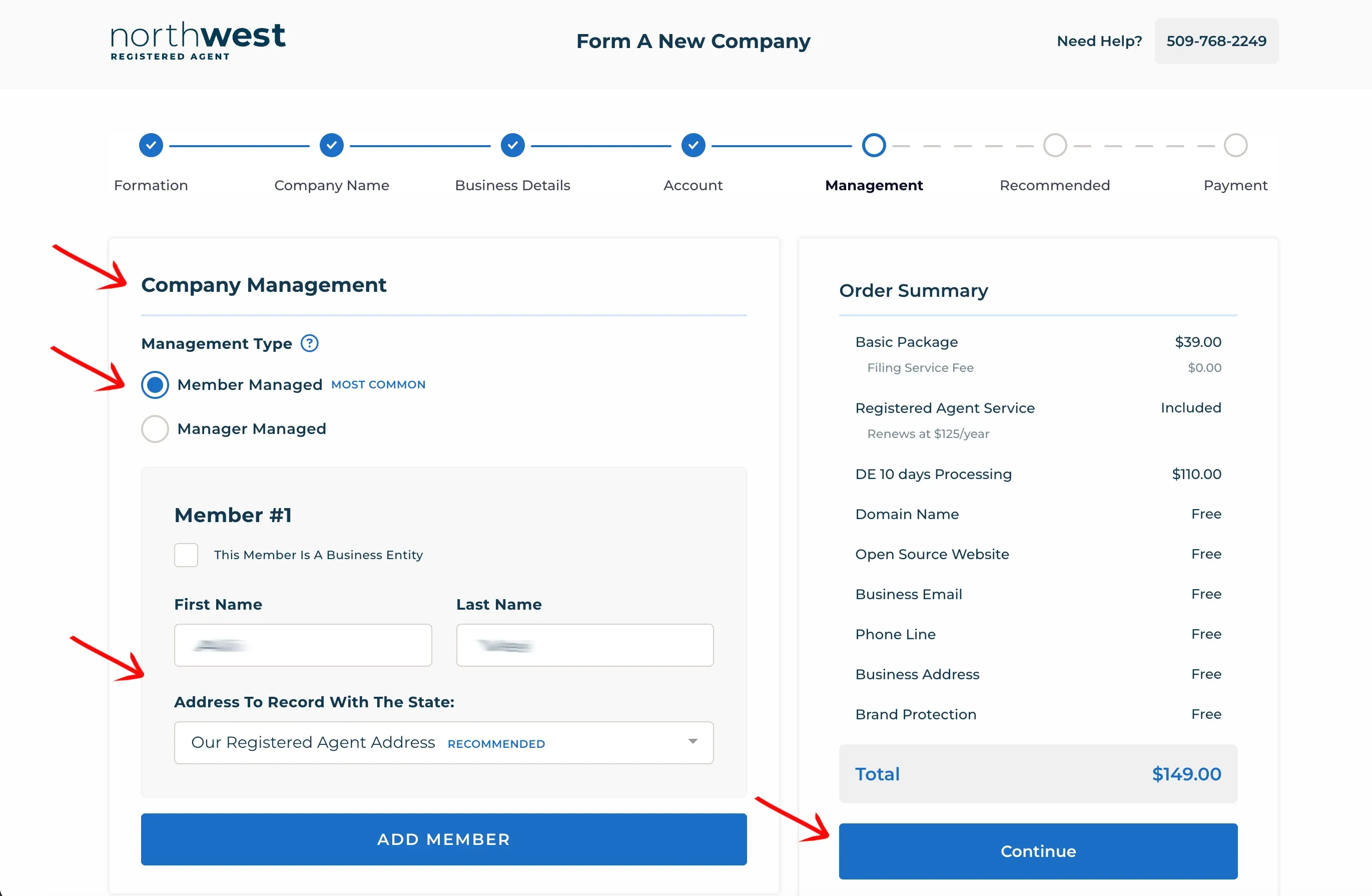
Record members or managers
Member-managed is the most common structure for small LLCs: the owners run the company directly. Manager-managed fits when investors or passive owners are involved.
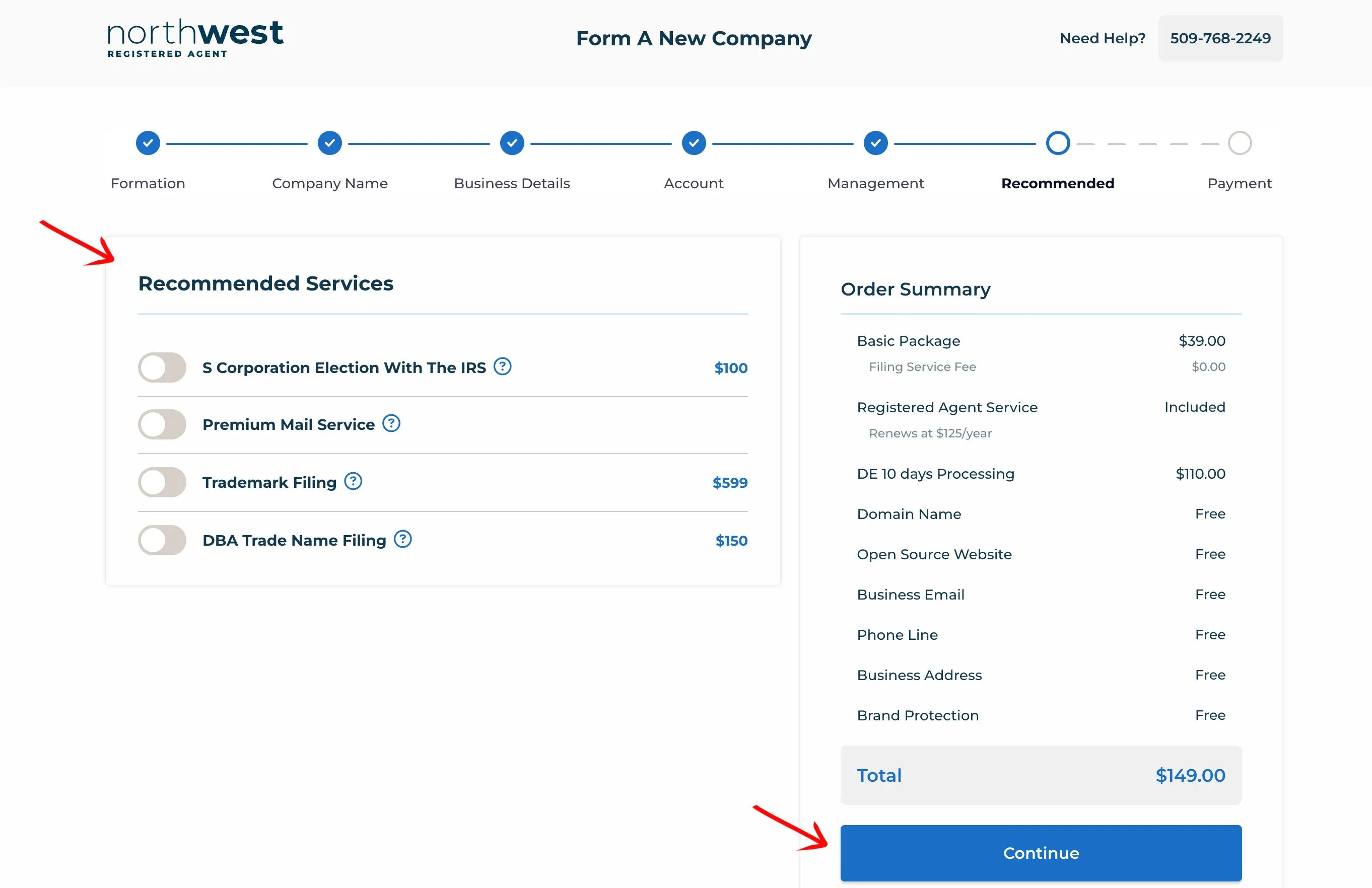
Optional add-ons (all of them can stay off)
S-corp election, trademark filing, and DBA registration are real services, but none is required to form the company. Leave every toggle off for a minimal filing; you can always add services later if you actually need them.
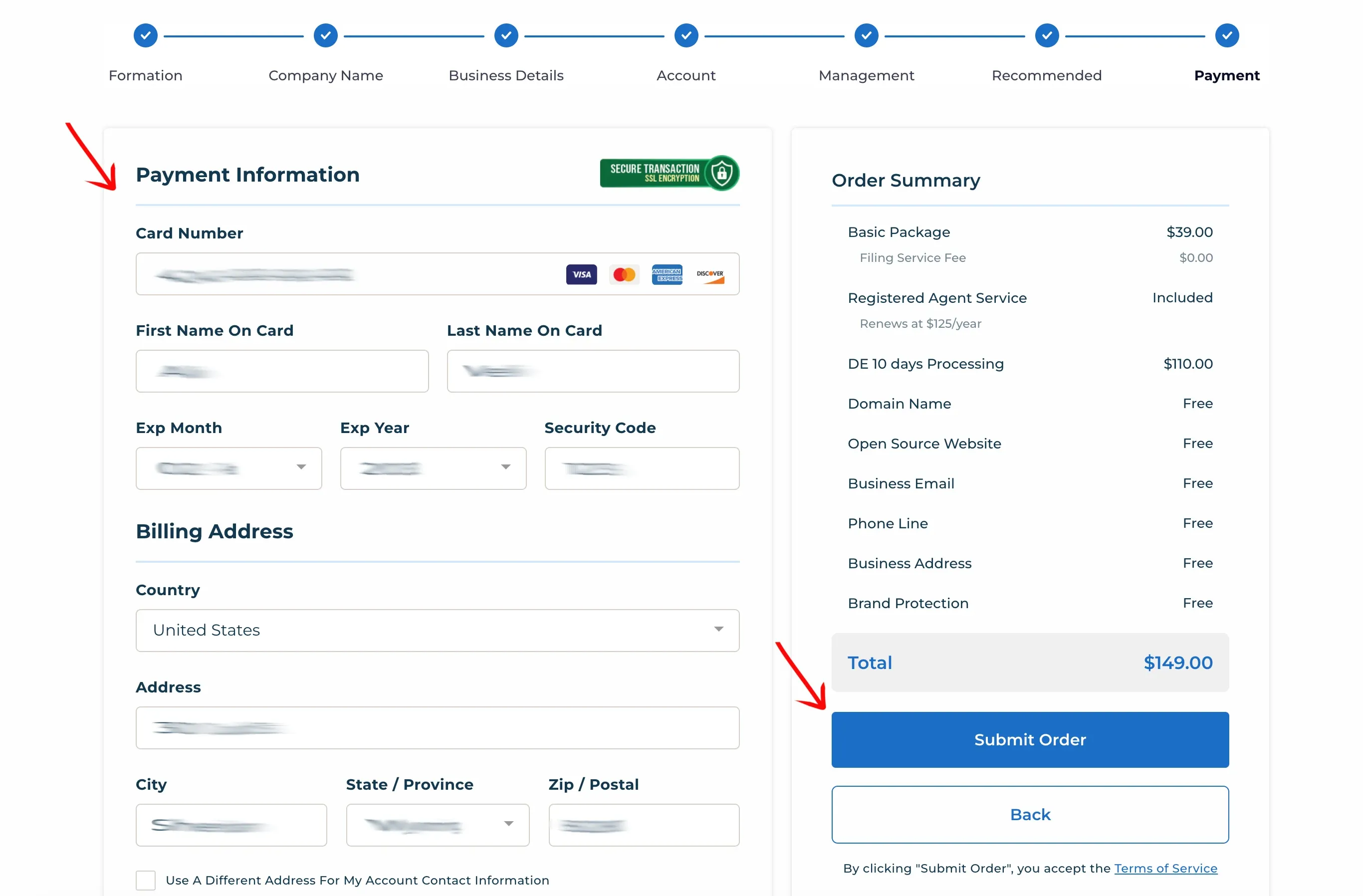
Review and submit the order
The order summary shows the service fee plus your state’s filing fee before you pay. After submission, the service prepares and files the formation documents with the state on your behalf.
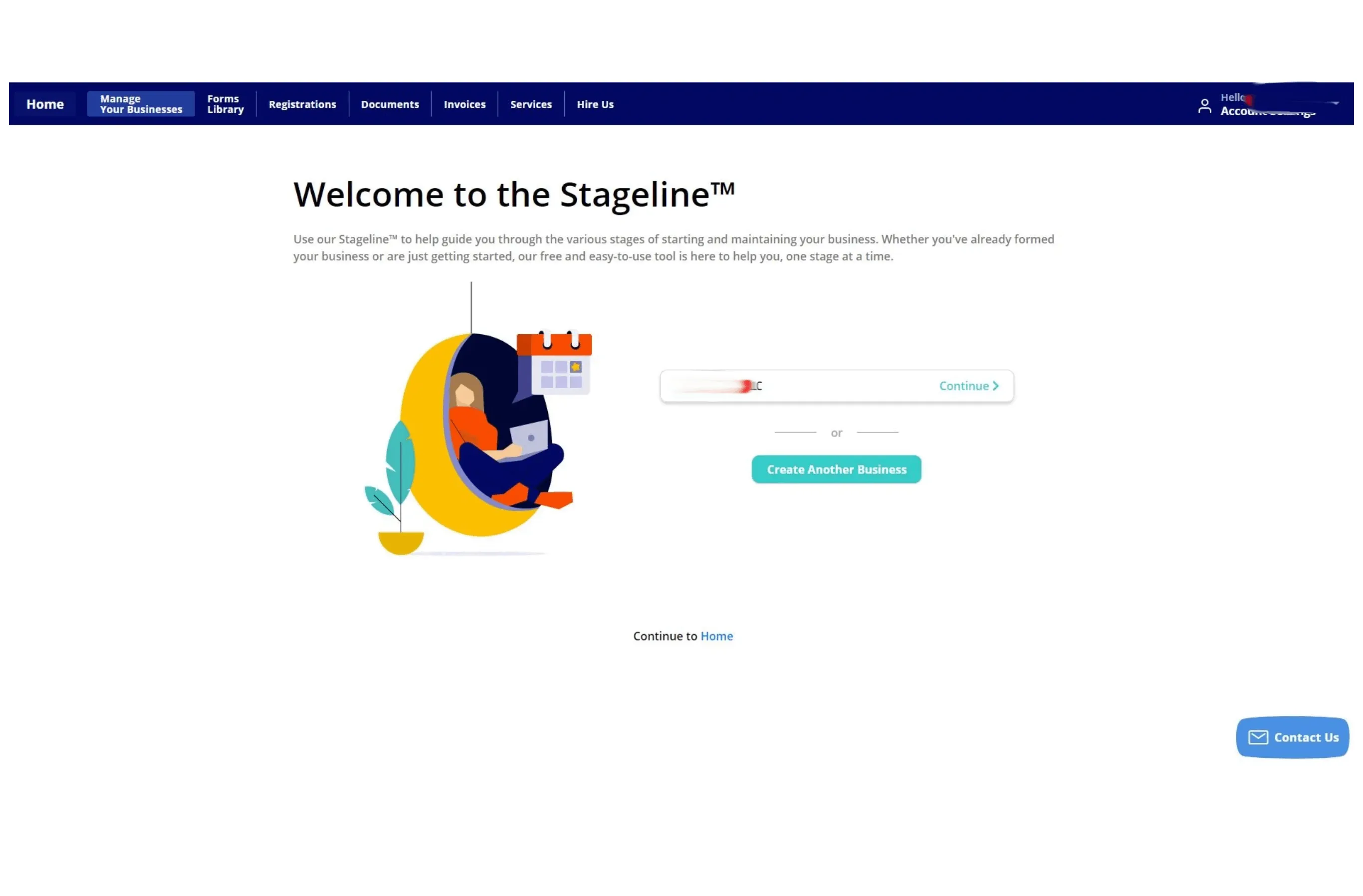
Confirmation: your filing is queued
The dashboard tracks the filing while the state processes it. Once the state accepts the documents, the name is legally yours in that state. This is the moment the claim actually happens.
Sponsored · We may earn a commission if you form through Northwest Registered Agent. Final name approval is always made by the state.
Step 5: Get your EIN, operating agreement, and bank account
Once the state accepts your filing, the name is claimed and the company exists. Three follow-ups make it operational:
- Get your EIN, free, from the IRS. The Employer Identification Number is the company’s federal tax ID, used to hire employees and manage federal tax obligations. A bank or licensing authority may also request it. The IRS online tool is for domestic organizations whose principal place of business is in the United States or a U.S. territory and whose responsible party has an SSN or ITIN. If the principal place of business is outside the United States, follow the IRS instructions to apply by phone, fax, or mail. Start with the official IRS EIN page.
- Adopt an operating agreement (bylaws for a corporation). Most states don’t require filing it, but banks ask for it and it governs what happens between owners when something changes.
- Open a business bank account. Keeping company money separate from personal money is what preserves the liability protection you just created. Banks typically want the accepted formation document, the EIN, and the operating agreement.
Step 6: Keep the business in good standing
A claimed name can be lost. States require an annual report (some biennial) with a fee, and your registered agent must stay current. Miss them long enough and the state moves the company toward administrative dissolution. At that point the name you claimed can eventually become available to someone else.
Sponsored · We may earn a commission if you form through Northwest Registered Agent. Final name approval is always made by the state.
Common questions about claiming a business name
Does searching for a name reserve it?
No. A search, whether on this site or on the state’s own website, only reads the register. The name is claimed when the state accepts a formation filing or a name reservation, and not before.
I have a business name, now what?
Verify it on the official state database, pick an entity type, appoint a registered agent, and file formation documents in that state. That sequence, Steps 1 through 4 above, is the entire legal path from name idea to registered company.
How much does it cost to claim a business name?
Doing everything yourself: the state filing fee, typically $35–$300 ($ in your state), plus $0 for the EIN. Optional costs: a name reservation fee if you need time, a registered agent service (~$100–300/yr), or a filing service such as Northwest at $39 plus the state fee.
Can I file the formation documents myself?
Yes. Every state accepts direct filings, most fully online, and the state does not treat self-filers any differently. Services save time and keep your address private; they are never a legal requirement.
How long does it take?
Online formation filings are processed in a few minutes to a few weeks depending on the state and season; most states also sell expedited processing. Eligible applicants who complete the IRS online tool may receive an EIN immediately if the application is approved. Other application methods take longer. Plan for the state’s standard processing time before you need the bank account.